

Les Paul Wiring: 50s vs 60s vs 60s Plus | ObsidianWire

Les Paul Wiring: 50s vs 60s vs 60s Plus | ObsidianWire

Which Les Paul wiring is right for you?

Three Classic Les Paul® Wiring Options:

The Les Paul has remained relatively unchanged since humbuckers were added in 57'. From then till now, three simple wiring layouts have remained dominant for their ability to draw out a myriad of soul turning sounds.

We have laid out what we know about the 'Vintage 50's', 'Modern 60's' and '60's Plus / Treble bleed' wiring, to help you find the best Les Paul wiring setup.

Quick comparison: Les Paul wiring types

The important point: your choice should depend on how you use your guitar's controls.

Vintage 50s Modern 60s 60s Plus
Main characteristic Traditional volume/tone interaction More independent controls Retains clarity as volume is reduced
Volume rolled back Can retain useful treble Can become darker Designed to retain more treble
Tone/volume interaction More interaction More independent More independent
Best suited to Volume-control players Traditional modern wiring Players wanting clarity at lower volume
Treble bleed No No Yes
Available in ObsidianWire systems Yes Yes

How does Les Paul wiring work?

A typical Les Paul has:

  • Two pickups
  • Two volume controls
  • Two tone controls
  • A three-way pickup selector
  • An output jack

Each pickup has its own volume and tone controls.

That independent control layout is what makes Les Paul wiring particularly interesting.

The wiring determines how the volume and tone circuits interact with one another and with the pickup as you adjust the controls.

With the controls fully open, different wiring arrangements can sound quite similar. The differences become much more apparent when you turn the volume or tone controls down.

This is why two Les Pauls with the same pickups can respond quite differently when you roll the volume back

The Big Three - Les Paul Wiring

  • Les Paul Wiring Diagram - Vintage 50s
     

    What is 50s wiring?

    50s wiring is a classic Les Paul wiring modification that changes the connection between the volume and tone controls.

    The important difference is where the tone circuit connects relative to the volume control.

    In simplified terms:

    Modern wiring

    Pickup → Volume → Tone

    50s wiring

    Pickup → Volume → Tone circuit connected differently

    That small change affects how the controls interact as the volume is reduced.

    What does 50s wiring sound like?

    One of the reasons players like 50s wiring is its behaviour when rolling back the guitar's volume.

    As you reduce the volume, 50s wiring can help retain more of the character and high-frequency content of the pickup than a conventional modern circuit.

    This can make the guitar's volume control particularly useful for moving between:

    Clean → edge of breakup → overdrive

    without reaching for the amplifier.

    That's one reason 50s wiring is especially popular with players who use their guitar volume control as part of their playing technique.

    Advantages of 50s wiring

    • Popular vintage-style Les Paul configuration
    • Can retain useful treble as volume is reduced
    • Excellent for players who ride the volume control
    • Works particularly well with responsive overdriven amplifiers
    • Simple, passive circuit

    Potential downside

    The volume and tone controls become more interactive.

    Changing the tone control can affect the way the volume control responds, and vice versa.

    For some players that's part of the appeal.

    For others, more independent controls are preferable.

    See Diagram
  • Les Paul Wiring Diagram - Modern 60s
     

    What is modern 60s wiring?

    Modern wiring is the conventional wiring arrangement found in many modern Les Paul-style guitars.

    It keeps the volume and tone controls more independent than the 50s arrangement.

    This can make the controls feel more predictable if you prefer each knob to perform its own job.

    What happens when you turn the volume down?

    One of the trade-offs is that reducing the volume can result in more noticeable high-frequency loss.

    How much you notice depends on the rest of the circuit, including factors such as:

    • Pickup characteristics
    • Potentiometer value
    • Potentiometer taper
    • Cable capacitance
    • Amplifier input characteristics

    So modern wiring isn't necessarily "bad" wiring.

    It's simply a different electrical relationship between the controls.

    Advantages of modern wiring

    • Familiar modern Les Paul arrangement
    • More independent volume and tone controls
    • Straightforward circuit
    • Works well for players who tend to leave the volume control high

    Potential downside

    Some players find that the guitar becomes noticeably darker as the volume is reduced.

    If you use your volume control heavily for cleaning up an amplifier, this may be less desirable.

    See Diagram
  • Les Paul Wiring Diagram - 60s Plus / Treble Bleed
     

    What is 60s Plus wiring?

    ObsidianWire's 60s Plus wiring is designed around a modern-style control arrangement with a treble-bleed circuit.

    A treble bleed is designed to help retain high-frequency content as the volume control is turned down.

    Instead of accepting the natural loss of treble that can occur as the volume is reduced, the treble-bleed circuit allows more high-frequency content to remain in the signal.

    Why use a treble bleed?

    Imagine your amp is set for a saturated overdrive.

    With the guitar volume at 10, you get:

    Full output → saturated sound

    Now roll the guitar volume back:

    Volume 10 → 7 → 5

    A treble bleed is intended to help the guitar retain clarity during that transition.

    The result can be a more consistent-feeling volume control, particularly for players who frequently move between different gain levels using the guitar's volume knob.

    Advantages of 60s Plus

    • Designed to retain treble as volume is reduced
    • Clearer response at lower volume settings
    • More independent volume and tone behaviour
    • Useful for players who frequently ride the volume control
    • Particularly useful when switching between clean and driven tones

    ObsidianWire uses its 60s Plus approach in its Les Paul wiring systems, including the MKII and Ultimate configurations.

    See Diagram

50s vs 60s vs 60s Plus: Which should you choose?

There's no universal winner.

The best choice depends on how you play.

Choose 50s wiring if you:

  • Regularly roll your guitar volume down
  • Use your volume control to clean up an amplifier
  • Like a traditional Les Paul response
  • Prefer a passive circuit without a treble bleed
  • Don't mind some interaction between volume and tone

Choose modern 60s wiring if you:

  • Want the conventional modern arrangement
  • Prefer more independent volume and tone controls
  • Generally play with the volume control high
  • Don't mind some treble reduction as volume is reduced

Choose 60s Plus if you:

  • Frequently use your volume control
  • Want to retain clarity as you turn down
  • Prefer more independent control behaviour
  • Want a treble-bleed solution
  • Like the idea of a more consistent response across the volume range

Hear the difference for yourself

The differences between these circuits are easiest to understand when you hear them.

Rather than relying entirely on descriptions such as "warmer", "brighter" or "more vintage", listen to how each circuit responds as the volume and tone controls are adjusted.

Pay particular attention to what happens when the volume control moves from:

10 → 8 → 6 → 4

That's where the differences between wiring approaches become most interesting.

Can you use different wiring for each Les Paul pickup?

Yes.

A typical Les Paul has separate volume and tone controls for the neck and bridge pickups.

That means the two sides of the guitar can be configured differently.

For example, you might prefer:

Bridge: 50s wiring

Neck: 60s Plus

That could give you a traditional volume-control response on one pickup while retaining additional clarity from the other.

This is one of the reasons Les Paul wiring can be so versatile.

The ObsidianWire Ultimate system takes this concept further, allowing selectable 50s and 60s Plus wiring for each pickup

Can you switch between 50s and 60s wiring?

With conventional wiring, changing between the two requires rewiring the guitar.

But you don't necessarily have to choose permanently.

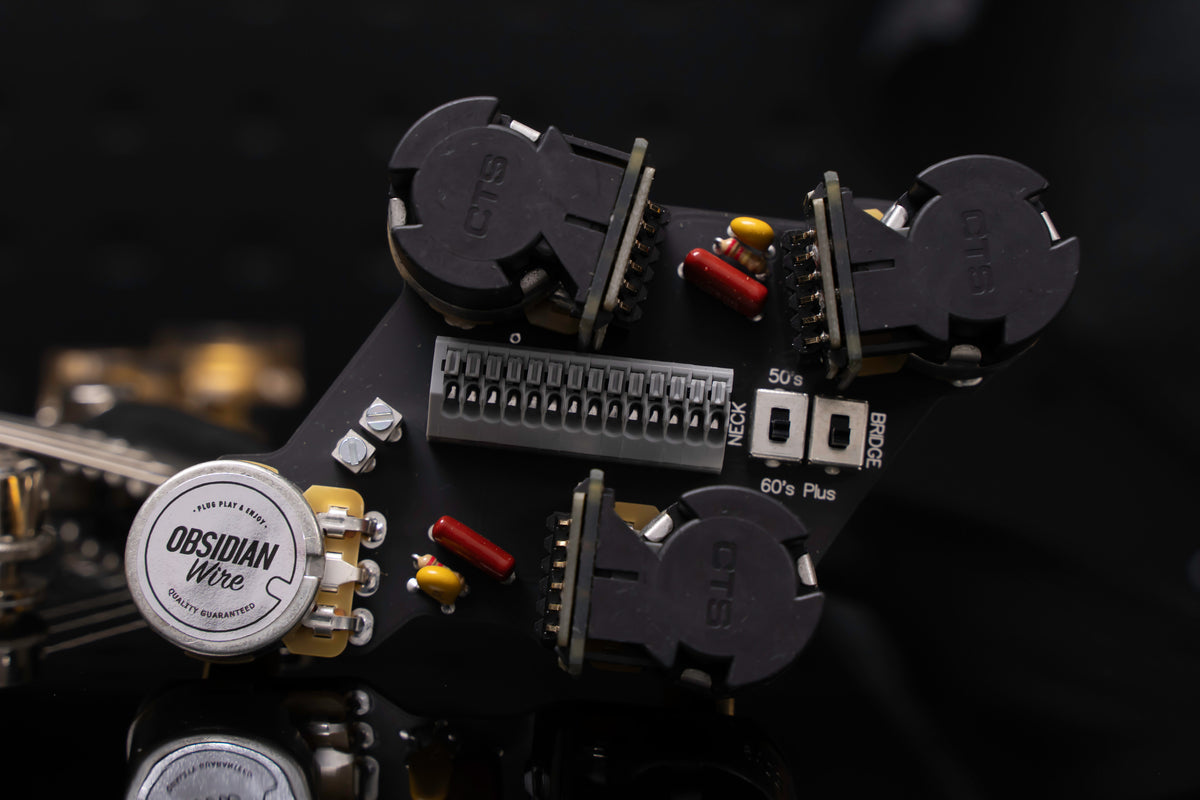
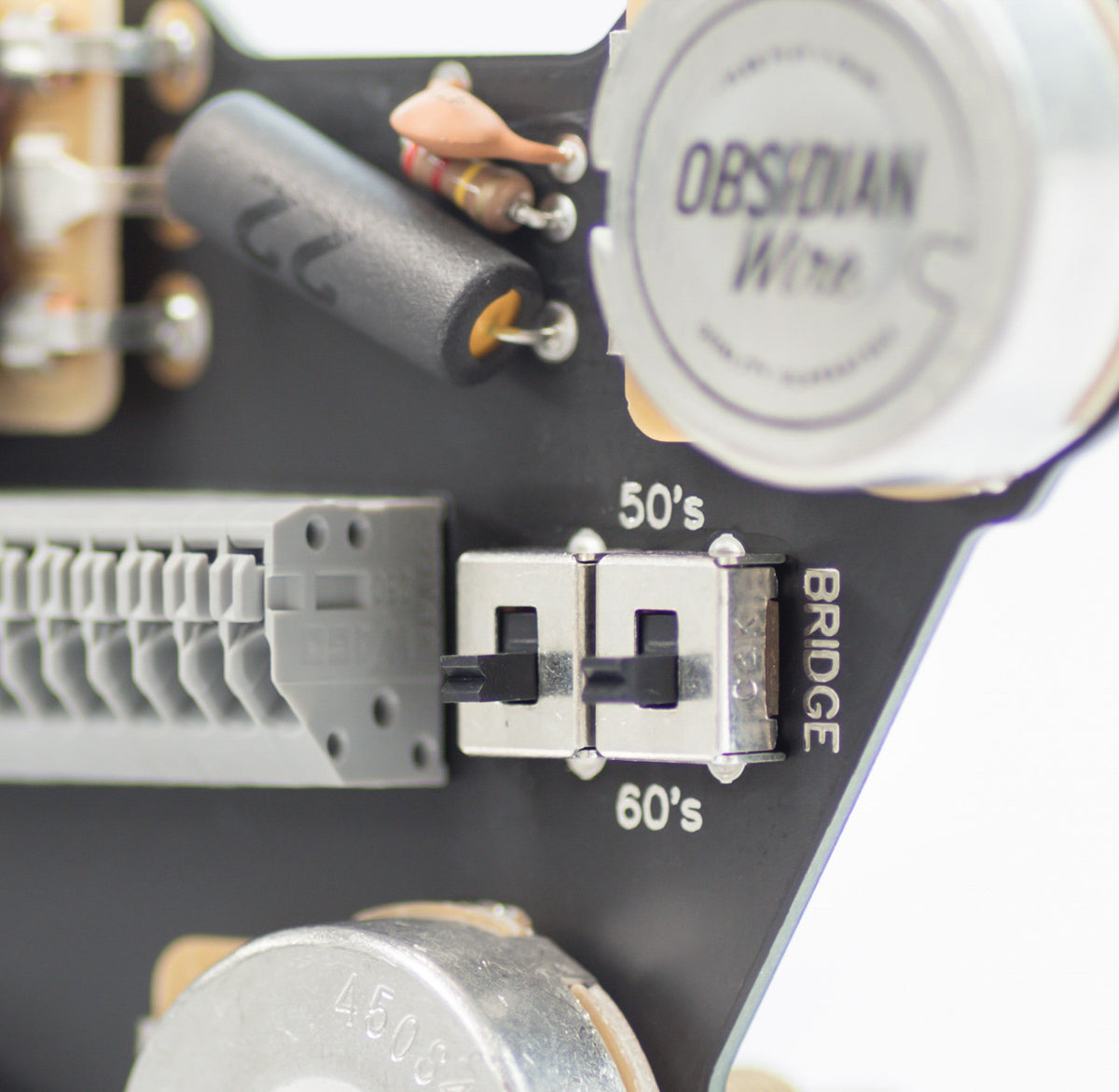
The ObsidianWire MKII

The Vintage MKII for Les Paul gives you selectable Vintage 50s and 60s Plus modes.

This means you can experiment with both approaches on the same guitar and decide which response suits you.

That's particularly useful if you're unsure whether you prefer traditional 50s wiring or the clarity of a treble-bleed approach.

The MKII is professionally assembled and uses 500k CTS potentiometers, 0.022µF capacitors and an ObsidianWire Pro-Wired toggle switch.

What is a treble bleed?

A treble bleed is a small circuit incorporated around the volume control.

Its purpose is to allow more high-frequency content to remain audible as the volume control is turned down.

Without one, the interaction between the volume control, pickup and rest of the circuit can cause the guitar to sound darker at lower volume settings.

With a treble bleed, more of that high-frequency information can remain.

Is treble bleed better?

Again, not necessarily.

Some players love the consistent clarity.

Others prefer the natural darkening that occurs when they roll back the volume.

It's a matter of playing style and preference.

That's why having the ability to compare different approaches can be more useful than simply being told which one is "best."

Does 50s wiring sound better?

Not automatically.

50s wiring has become popular because of the way it interacts with the guitar's volume control, particularly when cleaning up an overdriven amplifier.

But "better" depends on what you want from the guitar.

If you leave your volume at 10 most of the time, the difference may be relatively unimportant.

If you spend your entire gig moving between volume 10 and volume 5, the wiring can become much more noticeable.

The best wiring is the wiring that makes your guitar's controls work the way you want them to.

Does wiring change the tone of a Les Paul?

It can change the way the controls interact with the signal, particularly as you move the volume and tone controls away from maximum.

The wiring doesn't turn one pickup into another.

Instead, it changes the electrical relationship between the pickup, potentiometers, tone circuit and output.

That's why wiring modifications can be particularly noticeable when you're actively using the controls.

What about potentiometer value?

Potentiometer value is another important part of the equation.

Les Paul-style guitars commonly use 500k volume and tone pots, although actual resistance can vary.

A higher-value volume pot generally places less electrical load on the pickup, which can allow more high-frequency content through.

The actual behaviour of your guitar depends on the combined characteristics of:

  • Pickup inductance
  • Pot resistance
  • Pot taper
  • Tone capacitor
  • Wiring topology
  • Cable capacitance
  • Amplifier input

This is why two guitars with nominally identical wiring can still sound and respond differently.

Does the pickup matter?

Absolutely.

A wiring modification doesn't exist in isolation.

A bright, low-output PAF-style pickup and a hot ceramic humbucker may respond quite differently to the same wiring arrangement.

That's also why descriptions such as:

"50s wiring always sounds brighter"

should be treated carefully.

The actual result depends on the complete electrical system.

The most useful way to think about wiring is not:

Which circuit sounds best?

but:

Which circuit behaves best with my pickups, amplifier and playing style?

Can you use solderless wiring with a Les Paul?

Yes, with a compatible solderless harness.

A solderless wiring system replaces many of the conventional solder connections with purpose-designed connectors.

That can make installation and future compatible pickup changes considerably easier.

ObsidianWire's Les Paul systems are designed around solderless installation and include dedicated installation diagrams and compatibility information.

What pickups work with ObsidianWire Les Paul wiring?

Compatibility depends on the individual product and pickup wiring.

The ObsidianWire MKII supports both two-conductor and four-conductor pickup installations, while advanced functions such as coil splitting require four-conductor pickups.

The Ultimate JP Mod specifically requires four-conductor pickups because its additional coil-splitting functionality needs access to the humbucker's individual coil connections.

If you're unsure which wires your pickups use, check the pickup manufacturer's wiring diagram or ObsidianWire's pickup colour-code guide.

Which Les Paul wiring is best for you?

I want traditional Les Paul behaviour

→ Vintage 50s

A great choice if you like using your volume control to move between clean and driven sounds.

I want conventional modern wiring

→ Modern 60s

A straightforward option if you prefer more independent controls and don't rely heavily on rolling the volume down.

I want clarity when I turn down

→ 60s Plus

A treble-bleed approach designed to retain more high-frequency content at lower volume settings.

I can't decide

→ ObsidianWire MKII

Switch between 50s and 60s Plus and find out which you prefer.

I want everything

→ The Ultimate JP Mod

Selectable 50s / 60s Plus wiring plus coil splitting, series and phase switching.

What should you check before buying a Les Paul wiring harness?

  • Control-hole size

    ObsidianWire's Les Paul harnesses use 3/8" / 9.52mm mounting holes.

    Smaller holes can be reamed to fit the higher quality electronics.

    See
  • Potentiometer length

    The Les Paul harness uses long-shaft pots, with specific requirements depending on the guitar.

    This can also be used in Les Pauls that traditionally use short shafts, with the supplied height adjustment nuts.

  • Knob compatibility

    ObsidianWire specifies US-spec 24-spline knobs for its Les Paul harnesses.

    Metric/import knobs are not compatible.

    See Diagram
  • Pickup configuration

    If you want coil splitting, series or phase switching, check whether your pickups have the required four-conductor wiring.

  • Guitar model

    Most genuine Gibson Les Pauls are compatible with the relevant harnesses, while some Epiphone models require adjustments.

    Always check the individual product's compatibility information before ordering.

The Big Three - Les Paul Wiring Diagrams

  • Les Paul Wiring Diagram - Vintage 50s
     

    Les Paul 50s Wiring

    Its all in the order of the tone and volume controls. Vintage 50s wiring places your tone controls, after your volume controls.

    Vintage 50's Volume Control Wiring

    Lug 1: Input from Pickup HOT
    Lug 2: Output to switch + Tone Control Circuit
    Lug 3: Soldered to Ground / Back of Pot

    See Diagram
  • Les Paul Wiring Diagram - Modern 60s
     

    Modern / 60s Les Paul Wiring

    The modern 60's Les Paul wiring moves the tone control circuit in front of your volume controls.

    Modern / 60s Volume Control Wiring: 

    Lug 1: Input from Pickup HOT + Tone Control Circuit
    Lug 2: Output to switch
    Lug 3: Soldered to Ground / Back of Pot

    The ground wires, or outer braid of vintage style wires is soldered to the back of the pot.

    See Diagram
  • Les Paul Wiring Diagram - 60s Plus / Treble Bleed
     

    'Obsidian® 60's Plus' Wiring

    The Obsidian 60's Plus wiring is like the modern 60s wiring, but it includes a treble bleed mod. on each volume control.

    60s Plus Volume Control Wiring

    Lug 1: Input from Pickup HOT + Tone Control Circuit + Treble Bleed
    Lug 2: Output to switch + Treble Bleed
    Lug 3: Soldered to Ground / Back of Pot

    The ground wires, or outer braid of vintage style wires is soldered to the back of the pot.

    See Diagram

Les Paul Wiring FAQs

What is 50s wiring on a Les Paul?


50s wiring changes the connection between the volume and tone controls. It is particularly popular because of its behaviour when the guitar volume is reduced.

What is modern Les Paul wiring?


Modern wiring is the conventional arrangement used on many modern Les Paul-style guitars. It provides a more independent relationship between the volume and tone controls.

Is 50s wiring brighter than modern wiring?


It can retain more high-frequency content as the volume is reduced, but the actual result depends on the pickups, potentiometers, cable and other parts of the circuit.

What is 60s Plus wiring?


ObsidianWire's 60s Plus wiring combines modern-style control behaviour with a treble-bleed circuit designed to retain clarity as the volume is reduced.

Does 50s wiring affect tone?


It primarily changes how the volume and tone controls interact. The differences are generally most noticeable when the controls are adjusted away from maximum.

Can I switch between 50s and 60s wiring?


Yes, with an ObsidianWire MKII or Ultimate Les Paul wiring system.

Can I have different wiring for the neck and bridge?


Yes. A typical Les Paul has independent volume and tone controls for each pickup, allowing different wiring behaviour to be used on each side.

Do I need four-conductor pickups?


Not for basic wiring. However, advanced features such as coil splitting require four-conductor humbuckers. The Ultimate JP Mod requires four-conductor pickups.

Can I install a Les Paul wiring harness myself?

Yes, provided the harness is compatible with your guitar and you follow the installation instructions carefully. ObsidianWire provides a dedicated Les Paul installation guide with layout information, wiring diagrams and pickup colour-code resources.

Beyond 50s and 60s:

The Ultimate Les Paul Wiring

If choosing between 50s and 60s Plus isn't enough, ObsidianWire's Ultimate Wiring for Les Paul // JP Mod takes the concept considerably further.

It combines:

  • Selectable 50s / 60s Plus wiring
  • Dual coil splitting
  • Series switching
  • Phase switching
  • Push-pull controls
  • Solderless installation

The system is inspired by the versatile switching associated with Jimmy Page, while adding selectable 50s and 60s Plus wiring.

Coil splitting

Compatible four-conductor humbuckers can be split into single-coil operation.

Series switching

The neck and bridge pickups can be combined in series for a fuller, higher-output sound with increased midrange.

Phase switching

The pickups can be switched out of phase for the distinctive thin, nasal sound associated with classic out-of-phase Les Paul tones.

The additional functions are operated through three push-pull controls, meaning no additional holes need to be drilled into the guitar.

Vintage 50s / 60s Plus Switching

Obsidian® MKII for Les Paul®

Get easy access to the two best wiring options...

In a fully built, professional Les Paul wiring package, without the need to do any soldering at all

Super Easy, Solder-less Install
Key Features:

  • Selectable 'Vintage 50's' / '60's Plus' Wiring
  • Smoother Volume & Tone Control
  • Dual 'Split Coil' Upgrade Option
  • Includes Pro-Wired Switch & Jack
  • Fits Gibson® LP®
  • Fits Most Epiphone® LP® with adjustments